What is not in the box?
Every simulator brand sells the same promise: tour-level data and famous courses in your own home. The launch monitor delivers that. The trouble is everything around it, and that is where most home simulators go wrong.
A launch monitor does not know your ceiling has a duct over the hitting area. The projector does not know where your head will be at the top of the backswing. The screen does not know that your garage drops to 15 degrees in January. Somebody has to put those pieces together for your room. If you buy direct, that somebody is you.
Nine reasons to hire a custom integrator
1. LiDAR measuring
Most simulator mistakes start with a tape measure. People measure to the drywall and miss the duct. They forget the thickness of the hitting mat. They measure the wall and not the baseboard or the door casing. In a garage, they measure the ceiling and forget the door track and opener that sit right in the swing.
We scan the room with LiDAR, which captures the whole space in 3D: every beam, soffit, outlet, window and slope. Then we confirm the key dimensions with a laser measure and model the swing of the tallest golfer in your house. You see the result in a 3D design before anything is ordered.
Two inches is the difference between a full driver swing and a cracked ceiling. It is also the difference between a screen that fits and one that has to be sent back. Our room size guide explains the numbers.
2. Technology experience
A golf simulator looks like a golf product. Most of what makes it work is technology: a computer with the right graphics card, a projector matched to the screen and the room's light, network wiring, sensors that need a clean line of sight, and software that has to be updated. That is the work Boston Automations has done in New England homes for years.
Our parent company earned the 2024 Lutron Excellence Award and the 2024 Sonance + James Loudspeaker Project of the Year. We hold every simulator room to the same standard.
3. Six brands to choose from
A manufacturer will tell you its launch monitor is the right one. A single-brand shop will say the same about the brand it carries. We are an independent dealer for Golfzon, TrackMan, Foresight Sports, Full Swing and SkyTrak. We recommend the one that fits your room, your game and your budget, because we can sell you any of them. Our brand comparison shows how we think about it.
4. Dealer programs
Simulator manufacturers rely on authorized dealers to design and install their systems properly, because a badly installed simulator makes the brand look bad. So they support those dealers with programs the public does not see: dealer-only promotions and package bundles.
When one of those programs fits your project, you get the benefit. Either way, a boxed system still leaves the design, the trades and the calibration to you.
5. Builder and trade connections
Most simulator rooms need some construction: a new circuit, blocking in the ceiling for the projector, a heat pump in the garage, a duct moved out of the swing. We coordinate that with your builder. If you do not have one, we bring in local trades we trust and manage them for you, so you are not explaining swing clearance to an electrician.
We also work directly with builders and architects. Our trade checklist gives them the framing, power, pre-wire and HVAC details before the walls close, which is the cheapest time to get them right.
6. Whole-room design
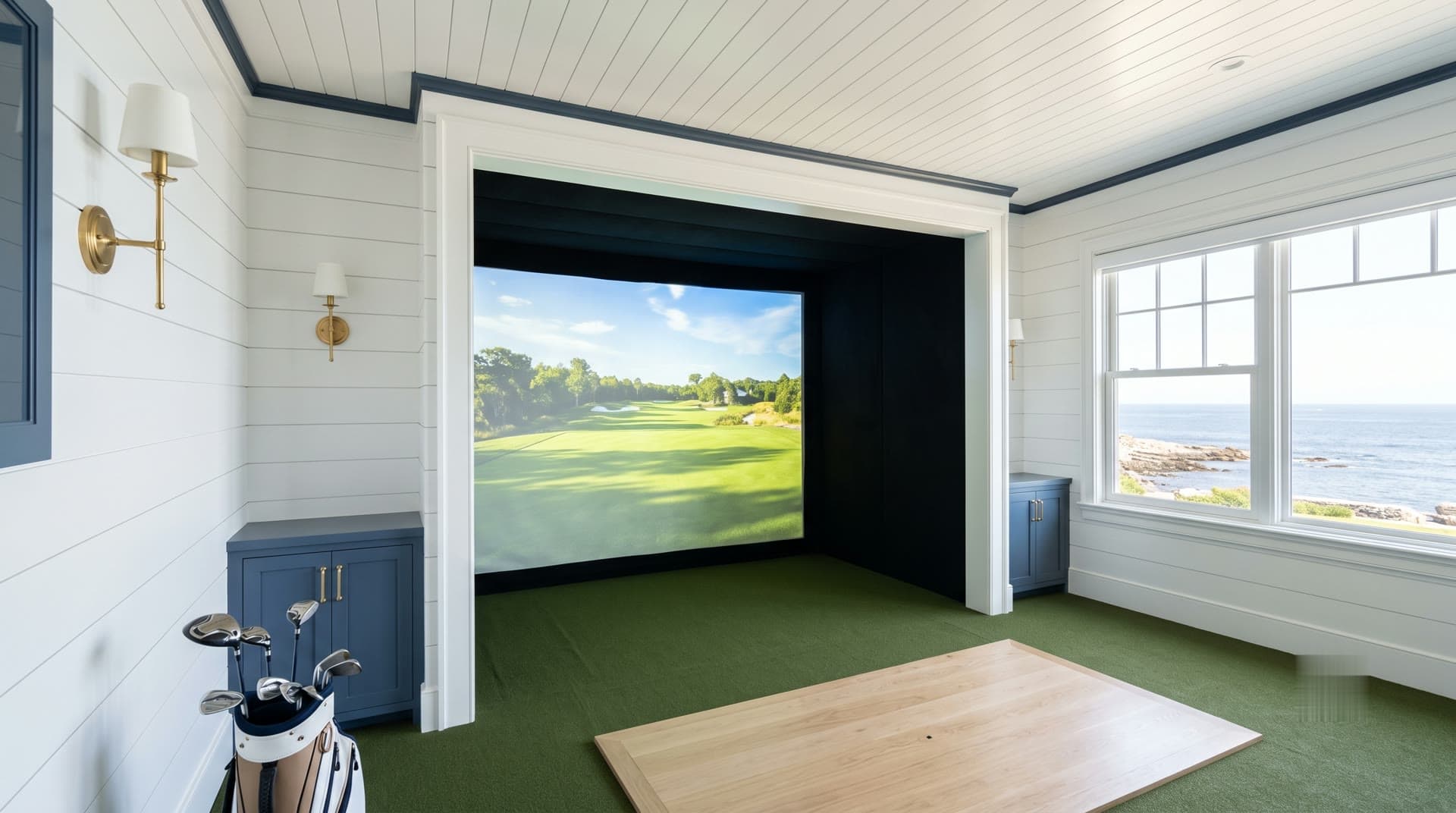
The best simulator rooms are where people want to spend a Friday night. That takes lighting that keeps the picture bright, speakers for music and course sounds, a TV for the game, seating, maybe a bar, and one keypad that runs it all. We design and sell all of it, because it is the same work Boston Automations does in the rest of the house. Our room design guide shows how the pieces fit.
7. One fixed price
When you buy direct, the price on the box is the start. The PC, the mounts, the electrician, the drywall patch and the second projector mount come later. We give you a 3D design and one fixed price for the equipment, the trades we manage, installation, calibration and training. You approve both before we start.
8. Calibration
The brands we install are accurate enough that tour players and club fitters rely on them. At home, that accuracy depends on the launch monitor being positioned, leveled and calibrated for your room, with lighting that does not interfere with it. We do that on every install and recheck it with seasonal recalibration.
9. Service after the install
A simulator is a computer, a projector, a set of sensors and a stack of software. Something will need attention eventually, and it usually happens on the night you have friends over. Our managed service covers remote monitoring, software updates, seasonal recalibration and priority on-site visits. If a part fails, we diagnose it and handle the hardware service, so you are not stuck between four support lines.
Going direct or working with us
| Step | Going direct | Boston Golf Simulators |
|---|---|---|
| Measuring | Your tape measure | LiDAR scan, laser confirmation and a swing model for every golfer |
| Choosing a brand | One brand's sales pitch | Six brands and a recommendation based on your room |
| Pricing | The box price, plus whatever comes up later | Dealer programs when they apply, and one fixed price up front |
| Construction | You find and manage the trades | We coordinate your builder or bring in trades we trust |
| Lighting, audio and control | Separate projects, if at all | Designed into the same room |
| Calibration | The setup guide | Calibrated on install and rechecked seasonally |
| After the install | Manufacturer support line | Managed service and one number to call |
So what does going direct really save?
On a packaged system, the installation fee, and sometimes a manufacturer's public sale price. For Foresight's SIM IN A BOX, our standard installation is $2,500 to $5,000, against a package that runs about $22,299 to $39,299 installed with a PC.
Now weigh that against the cost of one measurement mistake, a projector moved twice, a ceiling patched or a screen that has to be returned. Any one of those can cost more than the installation. On a custom room, the design and the trade coordination are where most of the value is, and those are not for sale in a box. Our DIY guide walks through the most common mistakes, and our cost guide shows the full budget.
When you might not need us
We would rather tell you this up front. If you want a portable launch monitor and a net in the garage for the off-season, you probably do not need an integrator. Set it up, hit balls and enjoy it.
Once the project includes a ceiling mount, an impact screen sized to the room, new circuits, a finished look, or lighting and sound, the number of things that can go wrong goes up quickly. That is where we earn our fee.
Questions to ask any installer
Whoever you hire, ask these before you sign. A good installer will have clear answers.
- Are you an authorized dealer for the brand you are recommending, and for its competitors?
- How will you measure the room, and what happens if the measurement is wrong?
- Who handles the electrical, framing and HVAC, and who manages them?
- Is the price fixed before work starts? What is not included?
- Who calibrates the launch monitor, and how often is it rechecked?
- Can you design the lighting, sound and control in the same room?
- Who do I call in a year when the software will not start?
Ask us the same questions. Send the room through our design consultation form, or check the fit first with our 3D room fit checker. We reply within one business day.
