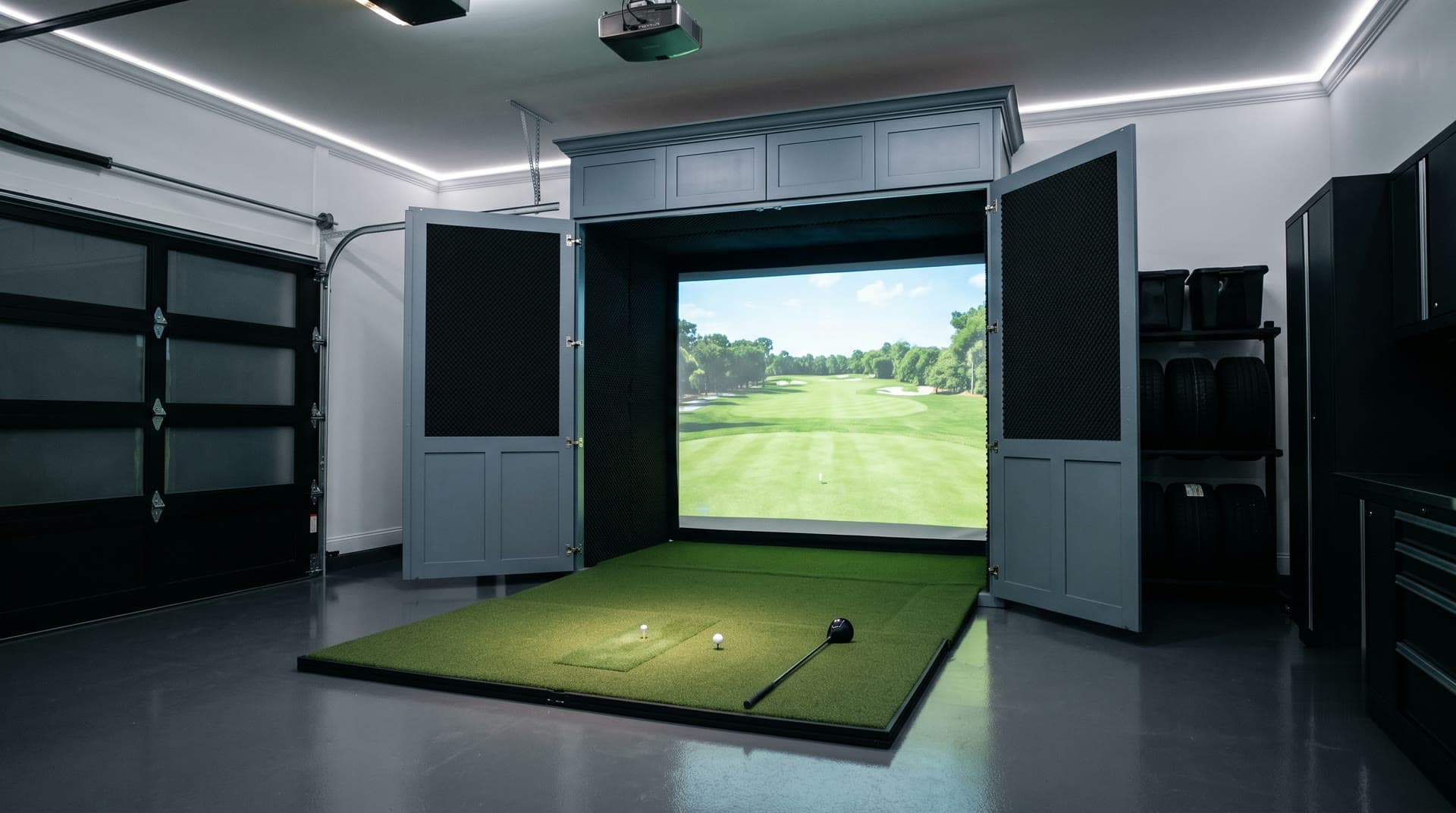
What a Murphy golf simulator is
The name comes from the Murphy bed. Instead of a bed folding into a wall cabinet, it is the hitting screen and the enclosure around it. The frame swings down on counterbalanced hardware, the same proven mechanics as a well-made wall bed, and folds back up when you are done.
Everything else stays out of the way. The launch monitor mounts on the ceiling or sits on the floor and is put away when the room is closed. A short-throw projector sits overhead. The hitting mat rolls up or slides away. Close it up and the room is a garage, basement, guest room or office again.
Fold-away options compared
| Type | How it puts itself away | Best for |
|---|---|---|
| Murphy cabinet | Screen and enclosure fold into custom wall cabinetry | Rooms that need to look finished when closed, such as guest rooms, offices and nice garages |
| Retractable screen | Screen rolls up into a ceiling housing, often with a motor, and side netting pulls back | Garages and basements where wall space is tight and a visible housing is fine |
| Portable enclosure | Frame folds or rolls to the side of the room | Occasional use and lower budgets, with more setup each time |
Our fold-away work centers on Murphy cabinetry. Which approach fits depends on how the room needs to look with the simulator closed and how much wall you can give up.
Room needs
A fold-away simulator needs the same space as a full bay when it is open. Most need about a 10 foot ceiling and 12 feet of width, with enough depth for the screen, the ball flight to the screen and the golfer. Our room size guide covers each dimension and how to test your swing.
Things to check in the room:
- A wall for the cabinet. The cabinet takes up a strip along one wall when closed. Windows, doors and outlets on that wall need planning.
- A clear ceiling. In a garage, the door opener and tracks are the usual problem. A wall-mounted opener often fixes it.
- Power and data. The projector, launch monitor and computer need power and a clean cable path that does not get pinched when the cabinet moves.
- Climate. A garage that freezes in winter is hard on electronics. Our unheated garage guide covers heat, humidity and condensation.
What a Murphy golf simulator costs
A Murphy simulator is a simulator plus cabinetry. Start with the simulator: the launch monitor, screen, projector, computer, software and installation. Then add the cabinet, the fold-away hardware and any motorization.
- Launch monitor. This is still the largest single choice. We put the same launch monitors in fold-away rooms as in dedicated ones, such as SkyTrak and Foresight.
- Cabinetry. Built to the room and finished to match the house. Paint-grade costs less than stained hardwood or custom veneers.
- Motorization and control. A motorized system that ties into the home's control system costs more than a manual one, and is far easier to live with.
- Room work. Heat for a garage, a new circuit or moving a garage door opener are common additions.
Our installed projects run from about $25,000 to $150,000 or more, and a Murphy design sits inside that range. Our cost guide breaks down each part of the budget.
How it folds away, step by step
- Open the cabinet. On a motorized system, one button or a scene on your control system does it.
- The screen and enclosure fold down on counterbalanced hardware and lock in place.
- Roll out the hitting mat. The projector and launch monitor turn on and the room is ready to play.
- When the round is over, reverse it. The whole process takes under a minute.
Motorized systems can also lower the shades, set the lights and start the projector in the same step, which is where our background in smart home control helps.
Is a Murphy simulator right for you?
It is a good fit if:
- The room has to stay a garage, gym, guest room or office.
- You want the room to look finished when nobody is playing.
- The room meets the height and width for a full swing.
A dedicated room is the better choice if the space can be given over to golf full time, or if you want a built-in platform such as a Golfzon swing plate. Our brand comparison helps with that decision.
