Golf simulator cost ranges
Prices online swing wildly because people are comparing different things. A launch monitor on a mat in front of a net is not the same purchase as a finished room. These are the three levels we see most in New England homes.
| Project | Typical installed cost | What it usually includes |
|---|---|---|
| Packaged system | About $22,299 to $39,299 with installation and a PC | Launch monitor, enclosure, screen, projector, mat and software in one kit, installed in a room that is already finished. |
| Custom bay | From about $25,000, most between $40,000 and $80,000 | A launch monitor chosen for the room, a sized enclosure or wall-to-wall screen, projector, turf, PC, and the electrical and mounting work to make it clean. |
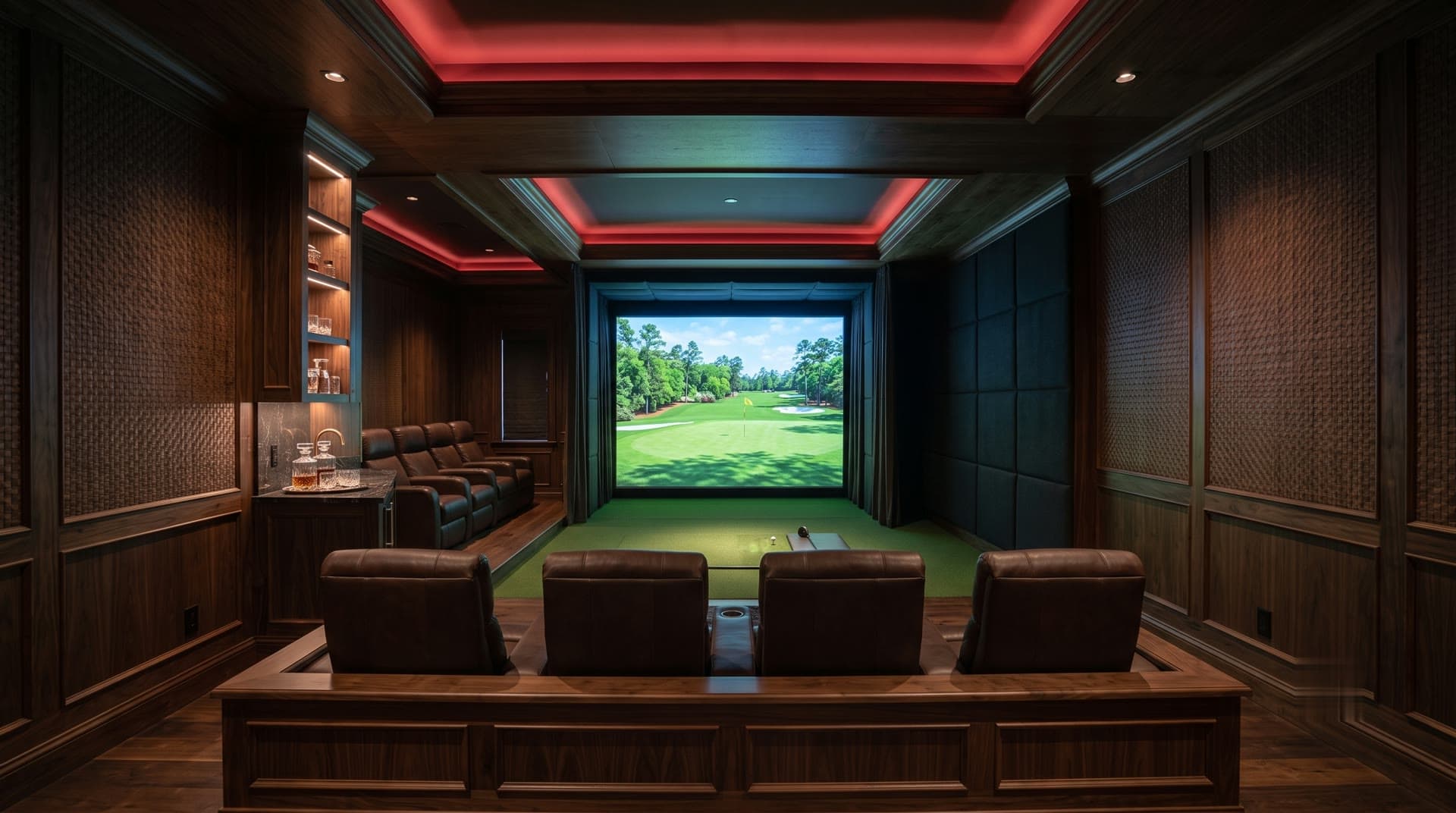
| Dedicated simulator room | Up to $150,000 and more | A premium platform such as Golfzon or TrackMan, room construction, lighting control, audio, acoustic treatment, seating and millwork. |
Our consultation form asks for a budget in five brackets, from under $25,000 to $80,000 and up, and most of our rooms land between $40,000 and $80,000. The brackets line up with the decisions that change the price most, and they help us suggest the right platform on the first call.
Where the money goes
Every installed simulator is built from the same parts. The price depends on which version of each part you choose and how much work the room needs.
The launch monitor
The launch monitor is the sensor that measures the club and the ball, and it is usually the largest single line. Photometric (camera) units from Foresight, radar units from TrackMan, and Golfzon's overhead sensors all sit at different prices. A ceiling-mounted unit costs more to install than a floor unit because it needs a mount, power and a data run in the ceiling. See our brand comparison for how they differ.
Screen, enclosure and projector
An impact screen in a framed enclosure is standard. A wall-to-wall screen with padded side walls looks more finished and costs more. The projector is usually short-throw and mounted so you do not cast a shadow on the screen. It also needs to be bright enough for the room's light.
Computer and software
Most platforms run on a Windows PC with a dedicated graphics card. Foresight's SIM IN A BOX ships without one, so we supply a PC built to Foresight's recommended specs for $3,800. Course libraries and advanced practice software are often an annual subscription, so plan for that in the yearly budget.
Turf, mat and flooring
A good hitting mat protects your joints and reads like real turf. Many rooms also carry turf across the floor and add a putting area.
The room itself
This is where New England projects vary most. A finished room with a 10 foot ceiling may need only an outlet and a ceiling mount. An unfinished basement or a cold garage can need framing, insulation, drywall, new circuits, a heat pump and lighting. We coordinate those trades or work with your builder.
Installation, calibration and training
Installation covers assembly, mounting, wiring, projector alignment, launch monitor calibration and showing the family how to use it. For a SIM IN A BOX, our installation is $2,500 to $5,000 depending on the room.
What a packaged system costs
Foresight's SIM IN A BOX Custom is a good reference because the price is public. At MSRP it runs:
- GC3: $15,999, or $18,999 with the frame extension
- GCQuad: $23,999, or $26,999 with the frame extension
- QuadMAX: $27,499, or $30,499 with the frame extension
- Foresight Falcon: $24,499, or $27,499 with the frame extension
Our standard installation is $2,500 to $5,000, and the PC is $3,800. Ceiling-mounting the projector or launch monitor adds installation cost. With installation and a PC, a package runs about $22,299 to $39,299 depending on the launch monitor and frame. You can build one on our SIM IN A BOX page and see the total before you call.
What changes the price in New England
A few things come up here more than they would in a warmer, newer housing market.
- Ceiling height. Many basements were poured with 8 foot walls and end up around 7 feet 6 inches once the floor, ceiling and ducts are in. Finding more height by opening the ceiling, moving ducts or digging down is the single biggest swing in room cost. Our low basement ceiling guide walks through the options.
- Heat and humidity. A garage bay that sits at 20 degrees in January and 80 percent humidity in July needs heating, cooling and dehumidifying to protect the electronics. See our unheated garage guide.
- Shared rooms. If the space has to stay a garage, gym or guest room, a Murphy or retractable simulator adds cabinetry or a motorized screen to the cost.
- Permits. Electrical and construction work needs a permit in most towns. The rules and timelines vary by town.
- Distance. We serve all of New England, Cape Cod and the Islands included. Island and far-north projects can add travel and freight.
Ways to spend less without regretting it
- Spend on the launch monitor and the screen. Those are what you feel every swing.
- Start with the room you already have. A finished bonus room often costs far less to convert than a new build.
- Wire for what you want later. Running power and data for a ceiling monitor or better audio during the build costs little, and it saves opening the ceiling again later.
- Check the software cost per year before you choose a brand. It adds up over five or ten years.
How we price a project
We start with your room. You can check the fit in our 3D room fit checker, then describe the room and upload photos on our consultation page. From there we hold a design call, measure and render the room, and give you one fixed price that covers equipment, room work we manage, installation, calibration and training. We reply within one business day.
